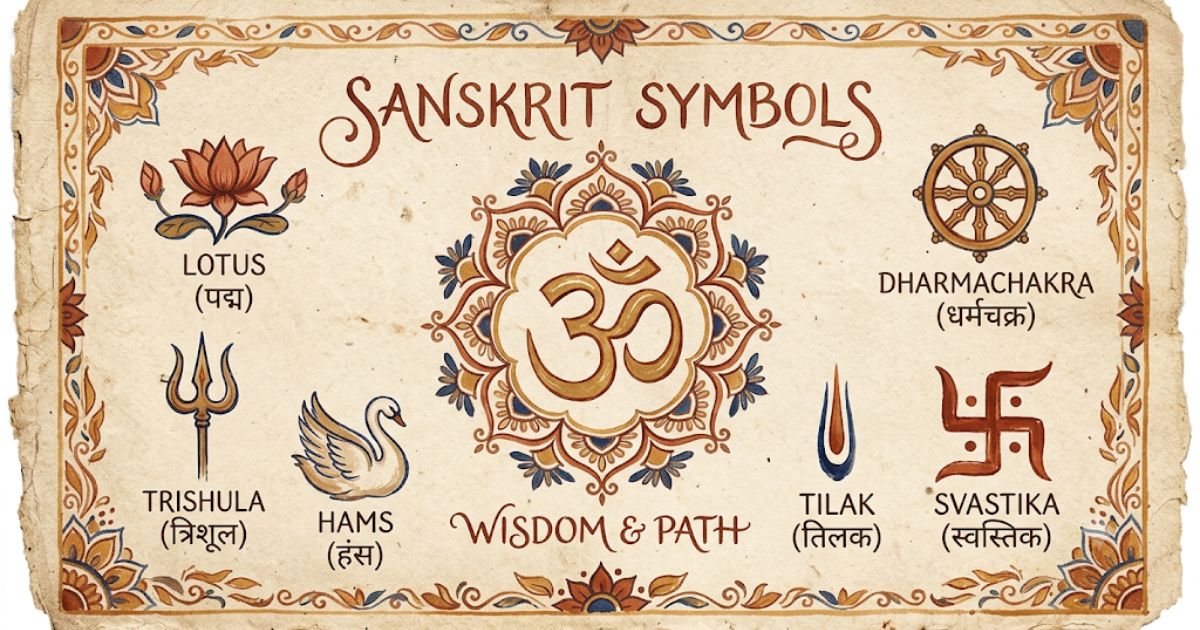
83+ Popular Sanskrit Symbols That Can Transform Your Life in 2026
Sanskrit symbols have guided humanity for thousands of years. From temple walls to modern tattoo studios, these sacred signs carry meanings that go far beyond words. Whether you seek peace, strength, balance, or spiritual growth, Sanskrit symbols offer a timeless connection to deeper truth.
This guide covers 83+ popular Sanskrit symbols, their spiritual meanings, tattoo uses, cultural impact, and why people around the world are still drawn to them in 2026.
What Are Sanskrit Symbols?

Sanskrit symbols are sacred visual signs rooted in one of the world’s oldest languages. Sanskrit, written in the Devanagari script, is more than just a communication tool. It is a spiritual system where every letter, sound, and shape carries energetic meaning.
These symbols appear in Hindu texts, Buddhist teachings, yoga practices, and ancient Indian philosophy. Unlike regular alphabets, Sanskrit symbols are believed to hold vibrational power. Chanting or simply viewing them is considered a sacred act in many traditions.
Key facts about Sanskrit symbols:
- Originated over 3,500 years ago in ancient India
- Written in the Devanagari script
- Used in Hinduism, Buddhism, Jainism, and yoga
- Each symbol connects to a specific energy, deity, or universal truth
- Found in temples, manuscripts, art, jewelry, and modern tattoos
Ancient Sanskrit Symbols And Their Spiritual Meanings
Ancient Sanskrit symbols were not created for decoration. They were tools for spiritual transformation, ritual practice, and connecting with the divine. Each symbol was carefully designed to represent a universal truth or cosmic force.
These sacred signs appear in the Vedas, Upanishads, and other ancient Indian texts. They were inscribed on temple walls, sacred objects, and manuscripts to preserve wisdom across generations.
Sanskrit Symbols And Meanings
Here is a quick reference table of the most widely recognized Sanskrit symbols and their core meanings:
| Symbol | Sanskrit Name | Meaning |
| Om (ॐ) | Aum | Universal sound, creation, consciousness |
| Lotus | Padma | Purity, spiritual awakening, transcendence |
| Swastika | Svastika | Well-being, good fortune, auspiciousness |
| Unalome | Unalome | Path to enlightenment |
| Shri Yantra | Sri Yantra | Balance, abundance, divine geometry |
| Dharma Wheel | Dharmachakra | Buddha’s eightfold path, liberation |
| Trishula | Trishula | Power of Shiva, creation, preservation, destruction |
| Hamsa | Hamsa | Protection, good luck, positive energy |
| Mandala | Mandala | Universe, wholeness, impermanence |
| Chakras | Chakra | Energy centers in the human body |
Buddhist Sanskrit Symbols And Meanings
Buddhist traditions adopted many Sanskrit symbols and gave them additional layers of spiritual meaning. These sacred signs appear in temples, prayer wheels, thangka paintings, and sacred scriptures across Asia.
Major Buddhist Sanskrit symbols include:
- Om Mani Padme Hum: The most famous Buddhist mantra, meaning “the jewel in the lotus.” Each syllable purifies a negative quality such as pride, jealousy, or greed and transforms it into wisdom.
- Dharmachakra: The eight-spoked wheel representing the Buddha’s eightfold path toward liberation.
- Unalome: A spiral symbol rising into a straight line, representing the winding journey of life that eventually leads to enlightenment.
- Lotus: Represents Buddha-nature present within every being, the inner capacity for awakening.
Ancient Sanskrit Symbols

The oldest Sanskrit symbols date back to the Vedic period. These ancient signs were used in fire rituals, sacred ceremonies, and spiritual manuscripts. Some of the most historically significant ones include:
- Svastika: Used for thousands of years as a symbol of good fortune before its misuse in the 20th century
- Bija Mantras: Seed syllables like Ram, Lam, and Ham that represent chakras and cosmic elements
- Devanagari letters: Each letter of the Sanskrit alphabet was associated with a deity, planet, or specific energy
Sanskrit Symbol For Life
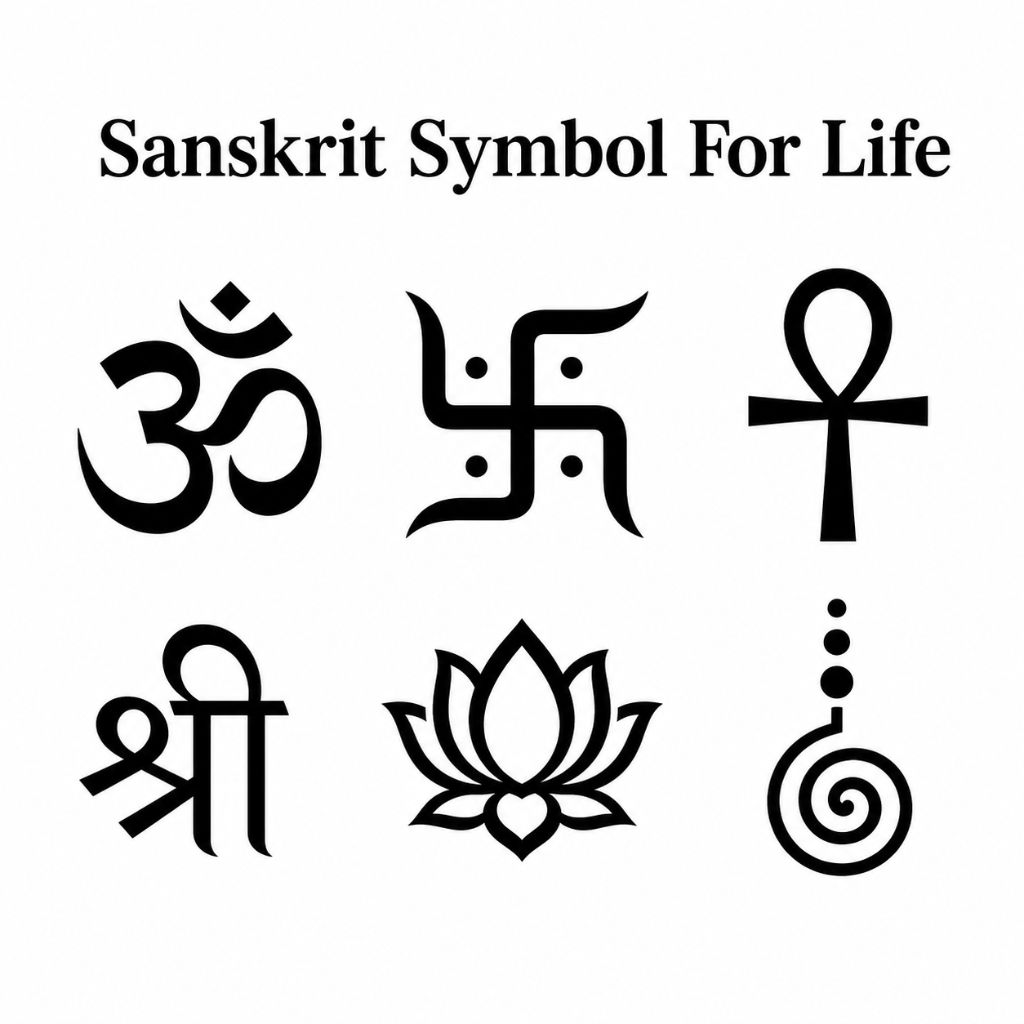
The Sanskrit symbol most connected to life is the Aum or Om. It represents the primordial sound from which all creation emerged. In yogic philosophy, Om is not just a symbol of life but the very vibration that sustains existence itself.
Other Sanskrit symbols connected to the concept of life include:
- Padma (Lotus): Growth, renewal, and spiritual rebirth
- Prana: The life force that flows through all living beings
- Ananda (आनंद): Bliss and the joy of being alive
Sanskrit Symbols For Breathe
Breath is central to yoga, meditation, and spiritual practice. Sanskrit symbols connected to breathing represent mindfulness, calmness, and the power of the present moment.
The most relevant Sanskrit breath symbols:
- Prana: The Sanskrit word for life force, directly tied to the breath
- Pranayama symbols: Used in yoga to represent controlled breathing techniques
- Om: Chanted during breathing exercises to calm the nervous system and center the mind
Many yoga practitioners use these Sanskrit symbols as visual reminders to slow down, breathe deeply, and stay present.
Popular Sanskrit Symbols In Tattoos And Modern Design
Sanskrit symbols have found a permanent home in modern tattoo culture. Their visual elegance combined with deep meaning makes them a popular choice for people wanting tattoos that say something real about who they are.
Sanskrit Symbols Tattoos

Sanskrit tattoo designs are chosen for their beauty and personal significance. Common tattoo placements include:
- Wrist or forearm: For mantras like Om Namah Shivaya as a daily reminder
- Chest area: For Om or Chakra symbols close to the heart
- Back: For larger designs like Mandalas representing the universe
- Fingers or collarbone: For small, elegant symbols like Om or Unalome
Sanskrit Symbols And Meanings Tattoos
Popular Sanskrit tattoo symbols with their meanings:
| Tattoo Symbol | Meaning |
| Om (ॐ) | Universal harmony, spiritual connection |
| Unalome | Journey toward enlightenment |
| Lotus | Rising above difficulties, inner purity |
| Hamsa | Protection from negative energy |
| Dharma (धर्म) | Duty, righteousness, moral order |
| Shanti (शान्ति) | Peace and tranquility |
| Ahimsa (अहिंसा) | Non-violence, compassion |
| Karma (कर्म) | Cause and effect, universal justice |
Spiritual Sanskrit Symbols
Spiritual Sanskrit symbols are widely used in meditation rooms, yoga studios, and personal altars. They create a calming atmosphere and serve as focal points for intention and mindfulness.
Top spiritual Sanskrit symbols include:
- Om: Universal spiritual starting point for all practices
- Shri Yantra: Geometric symbol for abundance and cosmic balance
- Chakra symbols: Seven energy centers mapped in the human body
- Mandala: Circle of life used in guided meditation
Sanskrit Symbols Text
Sanskrit symbols are also used in digital art, social media posts, quotes, and creative content. The Devanagari script gives written content a unique spiritual and artistic quality. Common text-based Sanskrit symbols include:
- ॐ (Om)
- श (Sha, peace)
- धर्म (Dharma)
- शान्ति (Shanti)
Symbols Of Sanskrit

The symbols of Sanskrit extend beyond single characters. They include complete mandalas, yantra diagrams, chakra wheels, and sacred geometric patterns. All of these symbols of Sanskrit share one common quality: they are considered not just visual images but actual carriers of vibrational energy.
Sanskrit Symbols Meaning
Every Sanskrit symbol carries meaning on multiple levels: phonetic, visual, spiritual, and philosophical. For example, the Om symbol visually represents three states of consciousness through its curves, while its sound represents the vibration of the universe itself.
Sanskrit Symbol For Balance
The most direct Sanskrit symbol for balance is the Shri Yantra. This complex geometric pattern features nine interlocking triangles: four pointing upward representing masculine energy and five pointing downward representing feminine energy. Their perfect intersection creates visual and spiritual equilibrium.
Other Sanskrit symbols for balance include:
- Chakra symbols: Representing balanced energy flow through the body
- Lotus: Balance between earthly struggle and spiritual purity
- Om: Balance between waking, dreaming, and deep sleep states of consciousness
Breathe Sanskrit Symbol
The breathe Sanskrit symbol is most closely associated with Prana. Prana means life force in Sanskrit and is directly connected to breathing. In yoga practice, Pranayama refers to breath control exercises used to manage energy and calm the mind. Many people tattoo Prana-related symbols as reminders to breathe through difficulty and stay grounded.
READ MORE: 55+ Mysterious Filipino Symbols
Deep Symbolic Meaning
Sanskrit symbols carry meaning on three levels. The surface level is their visual form. The middle level is their philosophical concept. The deepest level is their vibrational energy, which is believed to influence consciousness when seen, chanted, or meditated upon.
This is what separates Sanskrit symbols from ordinary logos or icons. In Sanskrit tradition, seeing the Om symbol is not just a reminder of peace. It is considered an actual encounter with the energy of Om itself.
Each Sanskrit symbol was designed with sacred geometry, precise proportions, and intentional symbolism. Nothing in their design is accidental. Every curve, angle, and proportion serves a spiritual purpose.
Types / Variations of Sanskrit Symbols
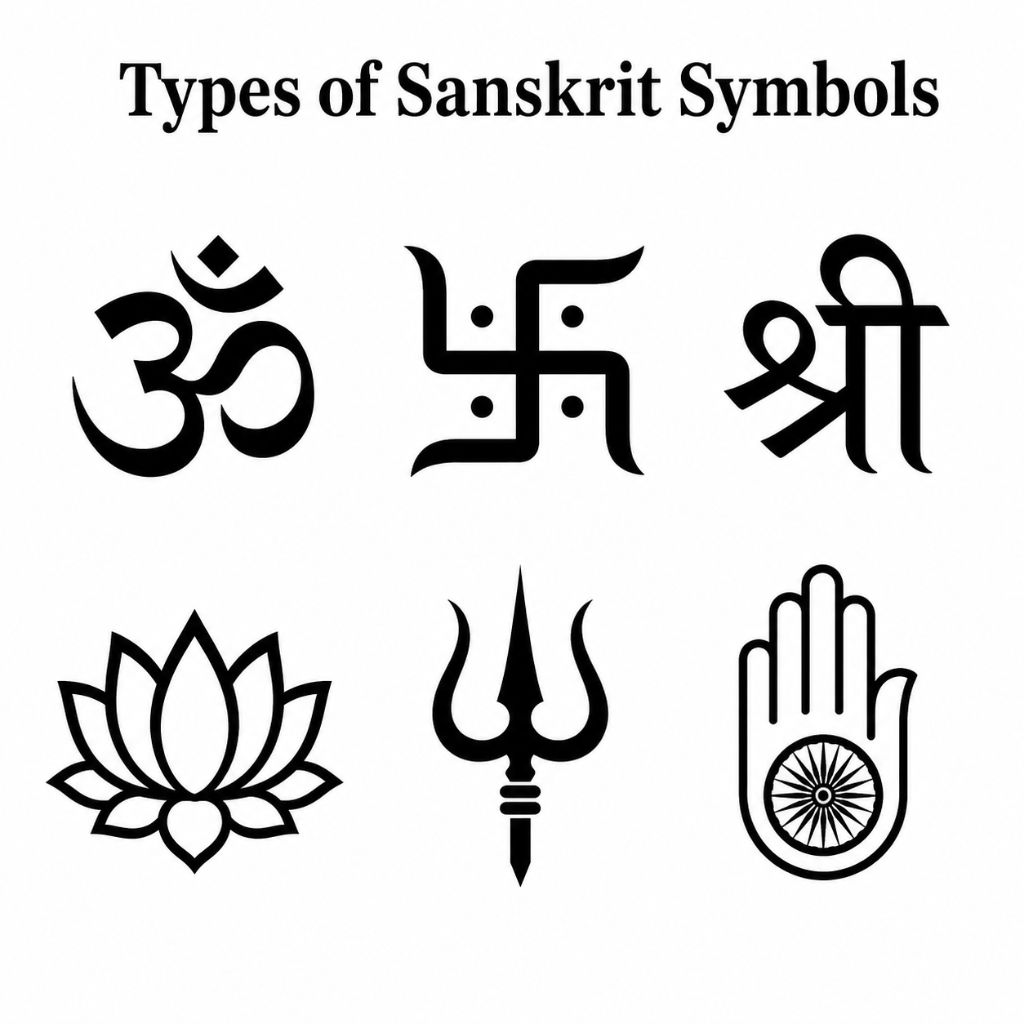
Om Symbol
Om (ॐ) is the most recognized Sanskrit symbol in the world. Its three curved lines represent the three states of consciousness: waking, dreaming, and deep sleep. The upper semicircle represents maya or illusion that blocks spiritual growth. The dot above represents the fourth state: pure transcendent consciousness. Om is used at the beginning and end of every Hindu prayer and yoga session.
Lotus Symbol
The lotus grows in muddy water but blooms clean above the surface. This makes it the perfect Sanskrit symbol for spiritual transcendence. In Hinduism, the lotus is associated with Brahma, Vishnu, and Lakshmi. In Buddhism, it represents the Buddha-nature within every being. The lotus is one of the most commonly used Sanskrit symbols in tattoos, art, and jewelry.
Swastika Symbol
The Swastika is one of the oldest Sanskrit symbols, derived from the Sanskrit word Svastika meaning “that which makes things good.” The clockwise swastika represents the sun, prosperity, and positive movement. It was a sacred sign of good fortune in Hinduism, Buddhism, and Jainism for thousands of years before its misuse in the 20th century. In its original spiritual context, it remains a powerful symbol of well-being.
Chakra Symbols
The seven chakra symbols are among the most detailed Sanskrit symbols in existence. Each chakra symbol includes a lotus flower with a specific number of petals, a geometric shape, and a bija seed syllable. The seven chakras are:
- Muladhara (Root Chakra) – survival and grounding
- Svadhisthana (Sacral Chakra) – creativity and emotion
- Manipura (Solar Plexus Chakra) – personal power
- Anahata (Heart Chakra) – love and compassion
- Vishuddha (Throat Chakra) – expression and truth
- Ajna (Third Eye Chakra) – intuition and vision
- Sahasrara (Crown Chakra) – divine connection and enlightenment
Mandala
The word mandala literally means “circle” in Sanskrit. Mandalas represent the cyclical nature of the universe and are used in meditation to symbolize impermanence and wholeness. Tibetan Buddhist monks create elaborate sand mandalas and then destroy them to demonstrate that nothing is permanent. In modern design, mandalas are widely used in art, home decor, and as tattoo designs.
Sanskrit Symbols Across Cultures

Sanskrit symbols have traveled far beyond India. Today they are used across the world in multiple cultural and spiritual contexts:
- In Japan and Tibet, Sanskrit symbols appear in Buddhist temples and manuscripts
- In the West, Om, the lotus, and chakra symbols are widely used in yoga studios and wellness spaces
- In Southeast Asia, Sanskrit-based symbols are woven into traditional art and ceremony
- In modern Western tattoo culture, Sanskrit symbols are among the most requested spiritual tattoo designs globally
This cross-cultural spread shows that Sanskrit symbols carry universal truths that resonate beyond any single religion or tradition.
Sanskrit Symbols in Art, Movies and Pop Culture
Sanskrit symbols appear regularly in mainstream culture. In movies like Doctor Strange, sacred geometric symbols inspired by Sanskrit and Hindu traditions are used as visual language for mystical power. In music, artists like Madonna and Rihanna have used Sanskrit mantras and symbols in their work.
In fashion and art, the Om symbol and lotus regularly appear on clothing, murals, home decor, and digital art. The growing popularity of yoga globally has brought Sanskrit symbols into everyday life for millions of people who may never have studied ancient Indian philosophy.
Spiritual and Dream Meaning of Sanskrit Symbols
Seeing Sanskrit symbols in dreams is often interpreted as a sign of spiritual awakening or a call toward inner growth. Common dream interpretations include:
- Dreaming of Om: A sign of spiritual protection and connection to universal energy
- Dreaming of the Lotus: A message to rise above current challenges
- Dreaming of Chakra symbols: An indication that energy alignment is needed
- Dreaming of the Swastika in its original form: A sign of incoming good fortune
In spiritual practices, these symbols are used intentionally before sleep during meditation to program the subconscious mind toward peace and clarity.
Positive vs Negative Meaning
Most Sanskrit symbols carry overwhelmingly positive meanings. However, context and intent matter significantly.
| Symbol | Positive Meaning | Potential Concern |
| Om | Universal peace, divine connection | None when used respectfully |
| Swastika | Prosperity, good fortune | Historically misused by Nazi Germany |
| Chakras | Energy balance, healing | Misunderstanding of cultural depth |
| Lotus | Purity, spiritual growth | None when used respectfully |
| Unalome | Enlightenment, personal journey | None when used respectfully |
The key principle is respectful use. Understanding a symbol’s true meaning before wearing or displaying it shows cultural appreciation rather than appropriation.
Why Humans Are Attracted to This Symbol
People are drawn to Sanskrit symbols for several reasons:
- Universal truths: These symbols represent concepts like love, peace, balance, and growth that every human being values.
- Visual beauty: The Devanagari script is aesthetically elegant, making these symbols naturally appealing in art and design.
- Spiritual hunger: In a fast-paced world, people seek symbols that connect them to something deeper and more meaningful.
- Proven history: These symbols have lasted thousands of years, which creates a sense of trust and authority.
- Personal transformation: Many people find that meditating on or wearing Sanskrit symbols genuinely helps shift their mindset and energy.
Conclusion
Sanskrit symbols are far more than decorative art. They are living tools for spiritual growth, personal transformation, and connection to universal wisdom. Whether you choose to meditate with the Om symbol, wear a lotus tattoo, or simply display a mandala in your home, each Sanskrit symbol carries the power of thousands of years of sacred knowledge.
As you explore Sanskrit symbols, take time to learn their true meanings. Respectful use of these symbols honors the cultures and traditions that created them. In 2026 and beyond, Sanskrit symbols remain as relevant, powerful, and transformative as they have always been.

Ethan Brooks is a writer and researcher at TechTimeGP, sharing clear and informative guides about symbols, signs, and their meanings. He explores the history, cultural significance, and modern uses of different symbols to help readers understand the stories behind them. His goal is to make symbol meanings simple, accurate, and easy for everyone to discover.